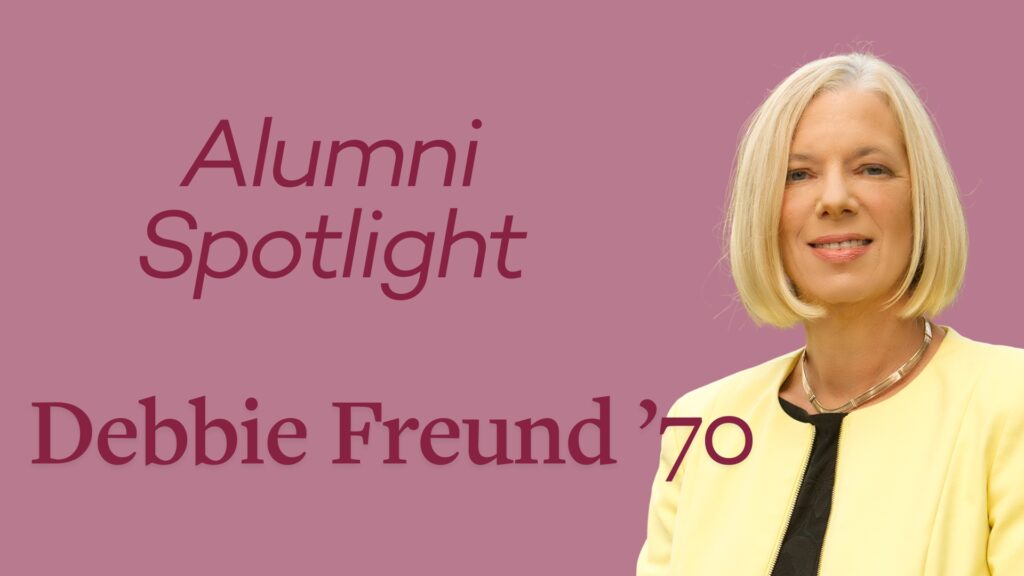
A pioneering researcher in Medicaid, health outcomes, and disparities as a health economist, Debbie Freund was the first person to negotiate Medicaid Managed Care contracts in New York state and helped implement the two-plan model in California. She was also the first female president of Claremont Graduate University, one of the Claremont Colleges, provost at Syracuse University, and vice chancellor and dean of the faculty at Indiana University. Freund has served as the principal investigator of $100 million in grants. She is President Emerita and a research professor at Claremont Graduate University and an adjunct professor of health policy and management at UCLA.
HOW HAS RIVERDALE MADE AN IMPACT ON YOUR LIFE?
I never thought about being an academic or getting a PhD, but there was something Riverdale had me do that I think really made all of my accomplishments possible. I took a lot of math and science classes, including AP classes, at a time when women didn’t do math and science. Women didn’t work! When I got to Washington University and talked about majoring in math and science, I was told that girls don’t do that. I ended up majoring in classical languages, partially because I had small classes when I took Latin at Riverdale, and that is where I learned to speak up. It has been really important in my career to learn how to speak up. Times have changed, but I think Riverdale empowered all of us in different ways.
HOW DID YOUR IMPRESSIVE CAREER IN HEALTH CARE BEGIN?
During a Washington University class, a speaker from the medical school spoke about starting a prepaid group practice (or what’s now called an HMO) at the medical school. I was fascinated and asked if I could shadow him. He asked me if I knew any computer science or statistics. Even though I was told I couldn’t major in math or science, I talked my way into a statistics class and a computer science class. I went to work for him, and he said, ‘You need to go to grad school in health administration. You would be great at it.’ Health administration was a program to learn how to run a hospital or insurance company. For my MPH at the University of Michigan, I was supposed to intern with the CEO of the Blue Cross and Blue Shield Association. I asked if I could work for a female CEO. They said, ‘No, there are no female CEOs.’ This was 1974. Two weeks later, they assigned me to the female director of New York state’s Medicaid program. I played a significant role in the development of Medicaid managed care, without initially realizing its full impact. As it spread nationwide, I began consulting with the federal government about it and testifying before Congress about it.
HOW DID YOUR ROLE AS AN ACADEMIC TAKE SHAPE?
When I was in grad school, I took a microeconomics course and a course in health economics, which was very new at the time. I did well in those classes, and the microeconomics professor said, ‘We’re going to start a new master’s program in applied microeconomics. Will you be the guinea pig, and we will pay for it?’ I was the first person to graduate from that program, and in the end, it was recommended that I stay a few more years. I got a second master’s, and they said, ‘Why don’t you stay and get a PhD?’ I absolutely had never envisioned getting one. There were no women faculty at the time. A PhD in economics is like a PhD in applied math – if you don’t know a lot of math, you can’t get your degree. I learned a lot of math at Riverdale, which gave me the basis I needed.
Being a provost or a college president never would have happened without my math and science background because I never would have gotten a PhD. I never would have received all those grants. I never would have been a successful professor.
During my time at the Girls School, they taught us everything that they taught the boys. We were empowered because maybe it was all women, so we weren’t afraid to speak out. It never occurred to me that I would have a career that demanded that I know so much math and science. I pushed past discouragement in college and kept going by following my interests. I never would have guessed that I would be successful, but I was the first Medicaid scholar in the country.